

The problem with the new COMPANY
#1The problem with the new COMPANY
Posted: 1/6/07 at 2:50amIMO, COMPANY is all about the emotions and the relationships and the building of the emotion and the relationships and the instruments get in the way. I felt this concept worked for Sweeney Todd, but I think the true connections don't happen in this COMPANY for this very reason
"He wants to know who cares. I care you stupid fool we all care..." John Wilkes Booth (Assassins)
neddyfrank2
Broadway Legend Joined: 12/23/05
COOOOLkid
Broadway Legend Joined: 8/15/05
#2re: The problem with the new COMPANY
Posted: 1/6/07 at 3:32am
He thinks the use of instruments in the show kinda interfered with the relationships/emotions within the show.
Am I right?
"Hey, you! You're the worst thing to happen to musical theatre since Andrew Lloyd Webber!"
-Family Guy

#3re: The problem with the new COMPANY
Posted: 1/6/07 at 3:44amokay?
"Passion can drive you crazy but is there any other way to live"
AngusN
Broadway Star Joined: 3/23/05
#4re: The problem with the new COMPANY
Posted: 1/6/07 at 6:21amI agree, I think the new stylised concept prevents us from becoming emotionally involved with these characters. Plus, the comic nature of the piece is lost.

#5re: The problem with the new COMPANY
Posted: 1/6/07 at 9:16amOy!
"Smart! And into all those exotic mystiques -- The Kama Sutra and Chinese techniques. I hear she knows more than seventy-five. Call me tomorrow if you're still alive!"
Mattbrain
Broadway Legend Joined: 11/23/05
#6re: The problem with the new COMPANY
Posted: 1/6/07 at 9:18amI don't think it works either.
Butters, go buy World of Warcraft, install it on your computer, and join the online sensation before we all murder you.
--Cartman: South Park
ATTENTION FANS: I will be played by James Barbour in the upcoming musical, "BroadwayWorld: The Musical."

BroadwayGirl107
Broadway Legend Joined: 8/26/03
#7re: The problem with the new COMPANY
Posted: 1/6/07 at 9:37amHm. I think it didn't work for Sweeney but it works beautifully for Company; perhaps i's partially because Sweeney is a narrative and Company is a concept show to begin with.
#8re: The problem with the new COMPANY
Posted: 1/6/07 at 9:40am
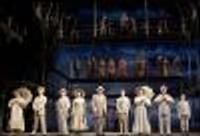
I've considered this a lot, because what's discussed here was initially one of the problems that I had with the piece as well. This is what I've come up with: I think that Doyle's Company works in a very interesting (and different) way than other productions of the show have. Rather than being about emotional connections, this Company takes a closer look at disconnection in the relationships in the show. The isolating nature of urban life takes center stage: Bobby is disconnected from everyone; the couples from one another. The positive aspects of couplehood with these people are still there, but they're muted somewhat, so what you see emphasized (and, presumably, what Bobby sees) are the negatives. This is just interpretation on my part, but I think the reason that Robert doesn't want to get married is because he sees the disconnect in his friends' marriages, and he wants something more than that...or else nothing at all. He's a romantic who uses bitter cynicism to shield himself from the pain of what he feels will inevitably be disappointment if he truly invests in a relationship.
If that's the case, it seems right that the instruments would "get in the way" of true connection. The couples are better off than Bobby because they're willing to make their own music, but there's also a lot of discord, and one hopes that, if and when Bobby does find someone, it's more emotionally true and harmonious than the relationships we've seen. We don't really know whether he'll find someone, but at least he's alive and looking. And even if he's alone, by the end of the show it seems he's strong enough that he's never going to fall back into the trap of watching other people live his life for him.

#9re: The problem with the new COMPANY
Posted: 1/6/07 at 12:01pm
Disclaimer: slightly different material than the notorious defensive rant.
Anthony Tommasini has an article in the Times this weekend (Arts and Leisure, Music section) in which he talks quite a bit about Company, and his interpretation of the concept's behavior. For me, he gets it. He talks about just what it is the instrument concept does for the piece, and echos Brantley's sentiment that it's not until Bobby's friends make music together that his problem is really driven home. It doesn't appear to be online yet, but it's worth a read when it goes up, or if anyone is able to find it.
I agree with sweetestsiren that this Company is about isolated disconnect, and probably much sadder than a show like Company might seem at first glance. The staging asks you to look at isolation, both within the marriages and between Bobby and his friends -- there are so many moments with unusual amounts of space between the charcters -- without insinuating that distance is the only thing at play. The relationships still work, but there is an isolated element. And for me, it's so deeply emotional because of that -- and because the instruments show it to you. Take Side by Side, for example. When nobody is there to answer Bobby's kazoo solo, he is for the rest of the song sidelined, alone, and absolutely freaking out. It's probably one of the show's most heartbreaking moments, and one of the best examples of moments in which the instruments demonstrate his isolation. There are also smaller moments to be caught. If you watch carefully, wives often instrumentally accompany their husbands (Sorry-Grateful is just one example of when this happens) or a couple will play off of one another and the instruments do help you see the bonds, too, but in much smaller ways. But back to the other point, the show is filled with moments in which Bobby just sits in the center while everyone sings, dances and plays instruments around him. The concept is very symbolic, but I think it really emphasizes Bobby's isolation from the group sensibility of being in a relationship. So I don't think BobPopa's assessment is wrong, per se, but nor do I think it's a "problem." I (obviously to most) think it's a strength.
This reminds of me something else I've been considering, too, which is how I'd react to seeing a traditional production after falling so in love with Doyle's interpretation (the first I'd ever seen). I keep saying to people that I can't see myself falling in love with a traditional production of the show, because Doyle's interpretation gives this production the emotional weight and darkness that's allowed it to be so moving for me. Last night, I watched a clip of a traditional production, and was disappointed to find myself saying "well, that's boring." This may be a bold, blasphemous statement, but for the above reasons and then some, I can't imagine being moved as much by a production without the instruments after seeing it this way. I think it's a show that'll be revived again within my lifetime, though, and I would love to see it despite that, in hopes of being proven wrong.
Videos