

#1
Posted: 12/14/09 at 3:42am
A fabulous item from 'The New York Magazine'
'Side by Side'
Stephen Sondheim and Angela Lansbury on a lifetime in theater.
by Jesse Green
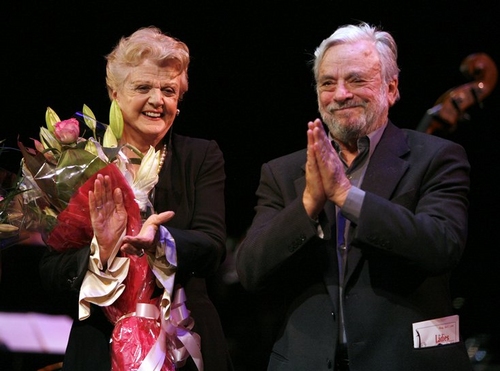
Actors are often slaves to authors, or at any rate authors are often
dictatorial toward actors, but Angela Lansbury, 84, and Stephen Sondheim,
79, have had a rare theatrical relationship, in a way helping each other
create, or reimagine, some of the landmark musicals of the past 45 years:
the 1964 cult flop Anyone Can Whistle; the great revival of Gypsy in the
seventies; Sweeney Todd in 1979; and the just-opened revival of A Little
Night Music, directed by Trevor Nunn and co-starring Catherine Zeta-Jones.
On the morning after the first preview, Sondheim and Lansbury-he weary from
the previous night, she chipper and ready for rehearsal-sat down at Sardi's
to discuss their collaboration. It began when Arthur Laurents, who was
directing Anyone Can Whistle, as well as writing its book, suggested casting
Lansbury in a leading role, despite not knowing if she could sing.
Angela Lansbury: I received a thin blue envelope with a thin blue piece of
paper inside, like toilet paper. It was a very nicely handwritten letter
from Arthur, asking if I might be interested in auditioning for the part of
Cora the Mayoress. The idea of being in a musical thrilled me!
Stephen Sondheim: You'd done the film The Harvey Girls, but they didn't use
your voice. So you hadn't actually sung with an orchestra in a movie, had
you?
A.L.: No, but you've forgotten that after leaving London during World War
II, I began my professional career in cabaret-in a Russian nightclub in
Montreal called the Samovar. I sang a lot of Noel Coward, and an arrangement
of "I Went to a Marvelous Party" with coloratura, contralto, mock German. I
had ideas of singing, but it was always a character singing, never straight
singing.
S.S.: Did you have eyes on a club career?
A.L.: No! I'd just come out of drama school, I was 16 years old, and I
needed to work because we had no money. When I got the job, I lied about my
age and went up to Montreal. I don't know how I had the gall to think I
could do this.
But by the time you got the letter from Mr. Laurents, you were a movie star
with two Academy Award nominations. Weren't you too established to audition
for a strange musical by a not-very-well-known composer?
A.L.: No. The theater always came first. Movies were incidental. So I was
happy to audition. I sang "A Foggy Day in London Town."
You took the role but soon discovered you weren't completely taken with it.
After all, Cora was not exactly a realistic character: the evil mayoress of
a bankrupt town who fakes a miracle to attract tourists. Did you try to
improve it?
A.L.: I'd like Stephen to take that question.
S.S.: Angie came over one afternoon while we were in rehearsal and said,
"Cora is a cartoon, and I don't know how to play a cartoon. I'm not that
kind of performer." I said, not bluntly, "You read the script and you knew
she was a kind of Kay Thompson substitute-the whole idea is that her
heartlessness and banality would be reflected in my heartless, jazzy
nightclub numbers." She had trouble with that-I'm putting words in your
mouth, Angie-because there was no there there. I didn't know what I could do
about that, but then she added, "And Lee [Remick, the other female lead] has
five songs while I have four." I said: "That I can solve."
You weren't above a bit of number-counting?
A.L.: I'm surprised that I wasn't, but . yes.
S.S.: So I wrote "A Parade in Town," which has some weight to it and is a
solo, giving the audience a chance to see Cora alone.
A.L.: It showed this very layered woman and gave me emotional heft, which
the part did not have before. It was a special thing he gave me, and I think
the reason we're sitting here today is because back then he recognized in me
a person who could deliver this kind of song in the way it was intended.
Stars do have to be deployed carefully to meet audiences' expectations. Is
there a way in which that's not just smart for them but for the architecture
of the piece?
S.S.: Yes, except sometimes it backfires. I thought if you're going to see a
show with two movie stars, you'd like to see them do a duet, so I devised
"There's Always a Woman." It lasted one performance. It was an eleven o'clock
number, but at that point in the evening, it already seemed like 11:30.
The tryouts in Philadelphia seemed cursed. Henry Lascoe, who played one of
Cora's henchmen, died; a musician in the pit died, too. And apparently Miss
Lansbury felt she was dying onstage.
A.L.: I was insecure and unhappy because I did not want to play the role the
way Arthur wanted to direct me-he knows this, I'm not talking out of school.
I remember standing at the top of the stairs in the theater in Philadelphia
and shouting, "I don't know what you want, and I can't do it!"
S.S.: And I remember how frightened I was. I thought, "She's going to quit,
she's going to quit." But something happened that restored your confidence.
A.L.: Audience reaction-simple as that. Now, I'm not a big audience-chaser.
I don't try to please them; I force them to pay attention to what I'm doing,
and get them that way.
The role established you in the musical theater, even though the show ran
for only nine performances on Broadway.
A.L.: Although 90,000 people apparently saw it.
S.S.: Closing night, I was in the wings when Angie was about to be carried
in on a palanquin by four guys for her first entrance. She said to them,
"Okay, let's give 'em hell." I cried.
She'd been through the London Blitz-she's a trouper.
S.S.: And she'd been through Arthur.
You didn't work together again until the revival of Gypsy. By then, Miss
Lansbury, you had carried major musicals-Mame and Dear World-and won two
Tonys. You could say no to anything.
A.L.: And I did. When they asked me, I said, "Oh, you've got to be kidding.
No way can I dare sing that!" I'd grown up listening to Ethel Merman
records.
S.S.:I never thought about the possibility of your being intimidated by the
memory of Merman.
A.L : Of course I was! But Arthur, again directing, said, "We know you can
sing it; we want you to act it."
S.S.: Ethel had one great strength: She knew how to play low comedy because
it was in her bones. She knew how to do double takes. But Angie was brought
up as an actress, so she had an entirely different take on Rose. Ethel was
not one for analysis of character.
A.L.: I did a lot of research. But for the purposes of the show, which
revealed only some aspects of Rose, I had to go with what the libretto said.
Consequently, what I came up with was maybe a little bit obvious.
S.S.: No, I think you came up with Arthur's Rose, which has nothing to do
with the real Rose Hovick.
A.L.: Well, if you start messing it up with the real Rose, you're in
trouble.
Yes, it's hard to imagine a lesbian scene in Gypsy.
S.S.:Not to mention that Rose was delicate. Even Bernadette Peters was a
little more robust than the real Rose. The only person who played Rose who
really looked like her was Linda Lavin.
A.L.: If I had been a little skinny woman, I would love to have tried to
approach it from that point of view.
But what you brought to Rose had its own authenticity.
S.S.:Early on, I said to Arthur, "What you're writing is so strong, I don't
know why it needs songs at all." He said, "Oh, no, if I were writing this as
a play, she'd be much more complex. When I write a musical it's in broad
strokes." And he's right. As musicals go, Rose is a very complex character;
as plays go, well, she's a musical-comedy character.
When you next worked together, on Sweeney Todd, the character was something
of both. And in a way, the tables had turned.
S.S.:This time, I had to audition for her.
A.L.: I was in Ireland when a woman called to say, "There's a telegram here
from New York from a fella named Harold Prince." Hal said he wanted me to
play the role of Nellie Lovett. I put down the phone and said to my husband,
"Hmmm, all right, this show is called Sweeney Todd, the Demon Barber of
Fleet Street. Then who is Nellie Lovett?"
S.S.:So I wrote half of her opening number, "The Worst Pies in London," to
show her. And because I wanted her to know that there was going to be some
music-hall stuff, I wrote "By the Sea."
A.L.: I understood Nellie immediately from those songs. This total London
Cockney from the streets. I knew women like that-women who worked for us.
Not women who were making pies out of people, but women with that wonderful
jolliness and "don't worry, I'll fix it" attitude. That was riveting to me.
S.S.:I told her what's fun about the characters is that the one who's
sympathetic is the morose, sullen murderer, while the one who's good company
is the real villain.
Miss Lansbury, you've been a good advocate for your characters.
S.S.:I remember that when we were picking the advertising for the show,
somebody came up with the lovely idea of using that drawing of the guy with
the knife, but it was just the guy. And Angie said, "You know, it's called
Sweeney Todd, but there is also Nellie Lovett." And so we put in the female
character with the rolling pin.
A.L.: If I may say so, I actually suggested the images in the first place.
They were from a card game in Britain called Happy Families. I believe they
were the butcher and his wife.
Speaking of happy families, do you two recall ever having an argument?
S.S.:No, but I don't remember having arguments with any actor. I mean, I
remember Zero Mostel having an argument with me, but I didn't have an
argument with him.
And is it true, Miss Lansbury, that you threw little pieces of dough at the
conductor in the pit, as has been reported?
S.S.:Angela does not break the fourth wall.
A.L.: I'm too busy staying behind the curtain in terror. Though, may I say
that I think I introduced a lot of humor into the playing of Sweeney Todd.
Which was unexpected and necessary. That was the Cockney way, you know. Her
logic and ingenuousness were what made her funny, and this is what allowed
one to be totally serious about the most dreadful idea.
S.S.:When an actor says, "I created the character," I used to think, "No,
you didn't; the authors did." But I came to understand what it means from
their point of view. Angie would question a line or an emotion or an
attitude and say, "This seems inconsistent." And if I agreed with her I
changed it. I mean, that's what you do with actors, right? Sixty percent of
the best plays in history have been written by actors. There's a reason for
that.
For the current revival of A Little Night Music, neither of you is creating
a role in that sense. Still, the part of Madame Armfeldt, first played by
Hermione Gingold, seems to have been written for someone like Angela
Lansbury.
A.L.: Interestingly, Hal Prince originally approached me about playing her
daughter, Desiree. I couldn't because I was doing Gypsy. But Armfeldt has
always been out there in the ether; it was a natural for me.
S.S.:After the run of Sweeney Todd Angie was really exhausted, what with the
constant running around the stage and up the stairs. She said, "What I want
now is a nice play where I sit behind a desk." Last night, watching Night
Music, in which she's in a wheelchair behind a tray table all evening, I
thought: Good for her-she finally got one.
A.L.: I like and understand Madame Armfeldt's indomitability, that she was a
courtesan of her time, and that she maintained this style because it brought
her monetary success, jewelry, recognition, a place in society. She didn't
come from any particularly great family, she just was terribly good at what
she did. To see that tremendous imperiousness crumble makes the part of
enormous interest to play.
And this time you weren't worried about dying onstage?
A.L.: I did say to Trevor, "Am I really going to die?" Because I thought,
"Maybe she could just drop off ."
S.S.:The original stage direction for her dying said that her wig slips
slightly off her head. After Gingold read and sang for us, she said, "I
notice certain characteristics that I share with Madame Armfeldt. In the
script she's 74 years old. Well, I'm 74." And she said, "I also notice that
in the last scene Madame Armfeldt dies and the wig slides off her head.
Well, gentlemen"-and she took her hair off and revealed an entirely bald
head. She said, "Thank you so much for seeing me," and left. And you heard
three jaws hit the floor. Hal said, "She's got the part."
She wasn't really bald, was she?
S.S.:I have no idea. But I'll tell you this: She was 75.
Miss Lansbury, would you ever go that far to get a role?
A.L.: No, I'd just act.


'Side by Side'
Stephen Sondheim and Angela Lansbury on a lifetime in theater.
by Jesse Green
Actors are often slaves to authors, or at any rate authors are often
dictatorial toward actors, but Angela Lansbury, 84, and Stephen Sondheim,
79, have had a rare theatrical relationship, in a way helping each other
create, or reimagine, some of the landmark musicals of the past 45 years:
the 1964 cult flop Anyone Can Whistle; the great revival of Gypsy in the
seventies; Sweeney Todd in 1979; and the just-opened revival of A Little
Night Music, directed by Trevor Nunn and co-starring Catherine Zeta-Jones.
On the morning after the first preview, Sondheim and Lansbury-he weary from
the previous night, she chipper and ready for rehearsal-sat down at Sardi's
to discuss their collaboration. It began when Arthur Laurents, who was
directing Anyone Can Whistle, as well as writing its book, suggested casting
Lansbury in a leading role, despite not knowing if she could sing.
Angela Lansbury: I received a thin blue envelope with a thin blue piece of
paper inside, like toilet paper. It was a very nicely handwritten letter
from Arthur, asking if I might be interested in auditioning for the part of
Cora the Mayoress. The idea of being in a musical thrilled me!
Stephen Sondheim: You'd done the film The Harvey Girls, but they didn't use
your voice. So you hadn't actually sung with an orchestra in a movie, had
you?
A.L.: No, but you've forgotten that after leaving London during World War
II, I began my professional career in cabaret-in a Russian nightclub in
Montreal called the Samovar. I sang a lot of Noel Coward, and an arrangement
of "I Went to a Marvelous Party" with coloratura, contralto, mock German. I
had ideas of singing, but it was always a character singing, never straight
singing.
S.S.: Did you have eyes on a club career?
A.L.: No! I'd just come out of drama school, I was 16 years old, and I
needed to work because we had no money. When I got the job, I lied about my
age and went up to Montreal. I don't know how I had the gall to think I
could do this.
But by the time you got the letter from Mr. Laurents, you were a movie star
with two Academy Award nominations. Weren't you too established to audition
for a strange musical by a not-very-well-known composer?
A.L.: No. The theater always came first. Movies were incidental. So I was
happy to audition. I sang "A Foggy Day in London Town."
You took the role but soon discovered you weren't completely taken with it.
After all, Cora was not exactly a realistic character: the evil mayoress of
a bankrupt town who fakes a miracle to attract tourists. Did you try to
improve it?
A.L.: I'd like Stephen to take that question.
S.S.: Angie came over one afternoon while we were in rehearsal and said,
"Cora is a cartoon, and I don't know how to play a cartoon. I'm not that
kind of performer." I said, not bluntly, "You read the script and you knew
she was a kind of Kay Thompson substitute-the whole idea is that her
heartlessness and banality would be reflected in my heartless, jazzy
nightclub numbers." She had trouble with that-I'm putting words in your
mouth, Angie-because there was no there there. I didn't know what I could do
about that, but then she added, "And Lee [Remick, the other female lead] has
five songs while I have four." I said: "That I can solve."
You weren't above a bit of number-counting?
A.L.: I'm surprised that I wasn't, but . yes.
S.S.: So I wrote "A Parade in Town," which has some weight to it and is a
solo, giving the audience a chance to see Cora alone.
A.L.: It showed this very layered woman and gave me emotional heft, which
the part did not have before. It was a special thing he gave me, and I think
the reason we're sitting here today is because back then he recognized in me
a person who could deliver this kind of song in the way it was intended.
Stars do have to be deployed carefully to meet audiences' expectations. Is
there a way in which that's not just smart for them but for the architecture
of the piece?
S.S.: Yes, except sometimes it backfires. I thought if you're going to see a
show with two movie stars, you'd like to see them do a duet, so I devised
"There's Always a Woman." It lasted one performance. It was an eleven o'clock
number, but at that point in the evening, it already seemed like 11:30.
The tryouts in Philadelphia seemed cursed. Henry Lascoe, who played one of
Cora's henchmen, died; a musician in the pit died, too. And apparently Miss
Lansbury felt she was dying onstage.
A.L.: I was insecure and unhappy because I did not want to play the role the
way Arthur wanted to direct me-he knows this, I'm not talking out of school.
I remember standing at the top of the stairs in the theater in Philadelphia
and shouting, "I don't know what you want, and I can't do it!"
S.S.: And I remember how frightened I was. I thought, "She's going to quit,
she's going to quit." But something happened that restored your confidence.
A.L.: Audience reaction-simple as that. Now, I'm not a big audience-chaser.
I don't try to please them; I force them to pay attention to what I'm doing,
and get them that way.
The role established you in the musical theater, even though the show ran
for only nine performances on Broadway.
A.L.: Although 90,000 people apparently saw it.
S.S.: Closing night, I was in the wings when Angie was about to be carried
in on a palanquin by four guys for her first entrance. She said to them,
"Okay, let's give 'em hell." I cried.
She'd been through the London Blitz-she's a trouper.
S.S.: And she'd been through Arthur.
You didn't work together again until the revival of Gypsy. By then, Miss
Lansbury, you had carried major musicals-Mame and Dear World-and won two
Tonys. You could say no to anything.
A.L.: And I did. When they asked me, I said, "Oh, you've got to be kidding.
No way can I dare sing that!" I'd grown up listening to Ethel Merman
records.
S.S.:I never thought about the possibility of your being intimidated by the
memory of Merman.
A.L : Of course I was! But Arthur, again directing, said, "We know you can
sing it; we want you to act it."
S.S.: Ethel had one great strength: She knew how to play low comedy because
it was in her bones. She knew how to do double takes. But Angie was brought
up as an actress, so she had an entirely different take on Rose. Ethel was
not one for analysis of character.
A.L.: I did a lot of research. But for the purposes of the show, which
revealed only some aspects of Rose, I had to go with what the libretto said.
Consequently, what I came up with was maybe a little bit obvious.
S.S.: No, I think you came up with Arthur's Rose, which has nothing to do
with the real Rose Hovick.
A.L.: Well, if you start messing it up with the real Rose, you're in
trouble.
Yes, it's hard to imagine a lesbian scene in Gypsy.
S.S.:Not to mention that Rose was delicate. Even Bernadette Peters was a
little more robust than the real Rose. The only person who played Rose who
really looked like her was Linda Lavin.
A.L.: If I had been a little skinny woman, I would love to have tried to
approach it from that point of view.
But what you brought to Rose had its own authenticity.
S.S.:Early on, I said to Arthur, "What you're writing is so strong, I don't
know why it needs songs at all." He said, "Oh, no, if I were writing this as
a play, she'd be much more complex. When I write a musical it's in broad
strokes." And he's right. As musicals go, Rose is a very complex character;
as plays go, well, she's a musical-comedy character.
When you next worked together, on Sweeney Todd, the character was something
of both. And in a way, the tables had turned.
S.S.:This time, I had to audition for her.
A.L.: I was in Ireland when a woman called to say, "There's a telegram here
from New York from a fella named Harold Prince." Hal said he wanted me to
play the role of Nellie Lovett. I put down the phone and said to my husband,
"Hmmm, all right, this show is called Sweeney Todd, the Demon Barber of
Fleet Street. Then who is Nellie Lovett?"
S.S.:So I wrote half of her opening number, "The Worst Pies in London," to
show her. And because I wanted her to know that there was going to be some
music-hall stuff, I wrote "By the Sea."
A.L.: I understood Nellie immediately from those songs. This total London
Cockney from the streets. I knew women like that-women who worked for us.
Not women who were making pies out of people, but women with that wonderful
jolliness and "don't worry, I'll fix it" attitude. That was riveting to me.
S.S.:I told her what's fun about the characters is that the one who's
sympathetic is the morose, sullen murderer, while the one who's good company
is the real villain.
Miss Lansbury, you've been a good advocate for your characters.
S.S.:I remember that when we were picking the advertising for the show,
somebody came up with the lovely idea of using that drawing of the guy with
the knife, but it was just the guy. And Angie said, "You know, it's called
Sweeney Todd, but there is also Nellie Lovett." And so we put in the female
character with the rolling pin.
A.L.: If I may say so, I actually suggested the images in the first place.
They were from a card game in Britain called Happy Families. I believe they
were the butcher and his wife.
Speaking of happy families, do you two recall ever having an argument?
S.S.:No, but I don't remember having arguments with any actor. I mean, I
remember Zero Mostel having an argument with me, but I didn't have an
argument with him.
And is it true, Miss Lansbury, that you threw little pieces of dough at the
conductor in the pit, as has been reported?
S.S.:Angela does not break the fourth wall.
A.L.: I'm too busy staying behind the curtain in terror. Though, may I say
that I think I introduced a lot of humor into the playing of Sweeney Todd.
Which was unexpected and necessary. That was the Cockney way, you know. Her
logic and ingenuousness were what made her funny, and this is what allowed
one to be totally serious about the most dreadful idea.
S.S.:When an actor says, "I created the character," I used to think, "No,
you didn't; the authors did." But I came to understand what it means from
their point of view. Angie would question a line or an emotion or an
attitude and say, "This seems inconsistent." And if I agreed with her I
changed it. I mean, that's what you do with actors, right? Sixty percent of
the best plays in history have been written by actors. There's a reason for
that.
For the current revival of A Little Night Music, neither of you is creating
a role in that sense. Still, the part of Madame Armfeldt, first played by
Hermione Gingold, seems to have been written for someone like Angela
Lansbury.
A.L.: Interestingly, Hal Prince originally approached me about playing her
daughter, Desiree. I couldn't because I was doing Gypsy. But Armfeldt has
always been out there in the ether; it was a natural for me.
S.S.:After the run of Sweeney Todd Angie was really exhausted, what with the
constant running around the stage and up the stairs. She said, "What I want
now is a nice play where I sit behind a desk." Last night, watching Night
Music, in which she's in a wheelchair behind a tray table all evening, I
thought: Good for her-she finally got one.
A.L.: I like and understand Madame Armfeldt's indomitability, that she was a
courtesan of her time, and that she maintained this style because it brought
her monetary success, jewelry, recognition, a place in society. She didn't
come from any particularly great family, she just was terribly good at what
she did. To see that tremendous imperiousness crumble makes the part of
enormous interest to play.
And this time you weren't worried about dying onstage?
A.L.: I did say to Trevor, "Am I really going to die?" Because I thought,
"Maybe she could just drop off ."
S.S.:The original stage direction for her dying said that her wig slips
slightly off her head. After Gingold read and sang for us, she said, "I
notice certain characteristics that I share with Madame Armfeldt. In the
script she's 74 years old. Well, I'm 74." And she said, "I also notice that
in the last scene Madame Armfeldt dies and the wig slides off her head.
Well, gentlemen"-and she took her hair off and revealed an entirely bald
head. She said, "Thank you so much for seeing me," and left. And you heard
three jaws hit the floor. Hal said, "She's got the part."
She wasn't really bald, was she?
S.S.:I have no idea. But I'll tell you this: She was 75.
Miss Lansbury, would you ever go that far to get a role?
A.L.: No, I'd just act.
Updated On: 12/14/09 at 03:42 AM