

#1
The Los Angeles Times:
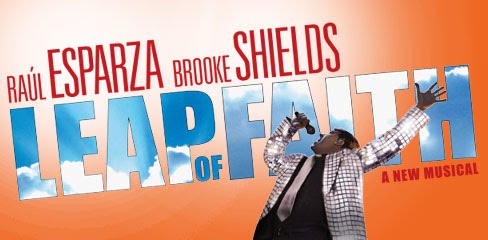
'Leap Of Faith -The musical'
by Charles McNulty
Compared to the preachers making scandalous headlines these days, Jonas
Nightingale, the con man at the center of the new musical "Leap of Faith,"
is practically a saint. No male hustler companion, no crystal meth, no child
molestation. For crying out the loud, the man doesn't even own a Bentley!
But this musical adaptation of the 1992 film starring Steve Martin doesn't
want to compete with nasty reality (or even the more nihilistic turns of the
movie). The show, which had its world premiere Sunday at the Ahmanson
Theatre, lingers in darkness only to revel in the relief of light. Jonas may
be guilty of racketeering, but as played by the seductive Raúl Esparza, a
Broadway star whose energy is as fierce as his talent, this evangelical
swindler conceals a tender heart behind a felonious sneer.
With a creative team that includes Disney movie composer and Academy
Award-hoarder Alan Menken, the musical strives to turn the fable into a
feel-good affair, complete with a tambourine-slapping gospel choir and
Brooke Shields as Jonas' love interest, Marva, the mother of a crippled boy
who's obviously a miracle waiting to happen. This erratic and somewhat
overeager production, directed and choreographed by Rob Ashford ("Curtains,"
"Promises, Promises"), stumbles to establish its drought-stricken
Sweetwater, Kan., world, catches fire during the tent revivals and races
toward an ending that dupes willing theatergoers as shamelessly as Jonas
hoodwinks the salvation-hungry masses.
True, much of the score is derivative, the dancing often seems like ballet
school parody, Shields' singing defensively retreats to the safest possible
key and the closing moments are pure sentimental hokum. But there's a
fascinating character in the middle it all, and a performance by Esparza
that digs deep into questions of faith, love and mystery. The show needs
another overhaul, but it's easy to see why the creators have persisted for
so long with this project: There's something uniquely compelling in the
source material. I hope the collaborators press on (Broadway is apparently
in their sights). They can begin with some radical pruning.
One easy suggestion: Drop the stylized dance preface that introduces the
Sweetwater locals, a group that's required to twirl and leap before corn
stalks without the benefit of "Oh, What a Beautiful Mornin'." Ashford's
trifling choreography turns the townspeople into rubes, easy prey for the
Angels of Mercy choir, which does most of the legwork for Jonas' scams.
While having breakfast at the diner, Jonas becomes smitten with Marva, a
waitress who's raising her son, Boyd (Nicholas Barasch), on her own after
the death of her husband in an accident that left her boy dependent on
crutches. (The musical's book, written by Janus Cercone with lyricist Glenn
Slater, alters and expands Cercone's screenplay.) As beautiful as she is
resistant to sweet-talkers, Marva is particularly cynical when it comes to
phony preachers, after a faith healer blamed Boyd for his failure to cure
him.
Jonas, who prides himself on his ability to read people, can't resist a
romantic challenge. He makes a bet with his sister, Sam (Kendra Kassebaum),
who masterminds his high-tech evangelical chicanery, on whether he can
conquer Marva. Little does he realize that his mercenary nature has a soft
spot that an openhearted youngster can slip right into.
Esparza plays Jonas as a fast-talking, Al Pacino-styled larcenist in a slick
black suit. As frauds go, he's a pretty transparent one. But his sexy
swagger gives him a decided advantage and, anyway, conversion is a fairly
rapid phenomenon in these parts. It only takes one house call before Shields'
Marva offers Jonas her hand to hold. But the tougher test will be whether
Boyd can redeem the soul of a wayward stranger through the force of his
belief in a happy ending for his lonely mom.
Attractive as ever, Shields turns Marva into a down pillow of emotion, all
feathery comfort and mushy concern. Her hard-edged retorts wouldn't scare
off a boy scout collecting donations for his troop. With a watery glance,
she imparts gallons of musical theater sentiment. You care about her, even
though in real life such heartbreaking innocence would undoubtedly get taken
to the cleaners.
Marva is "long passed dreamin'," to borrow a line from Slater's typically
corny lyrics, yet she's willing to take another shot at love. Shields makes
her musical confessions in a voice so tentative that it's easy to imagine
cast members backstage crossing their fingers for her.
Her lack of musical bravado is particularly noticeable in an ensemble that
keeps unleashing thundering vocalists, like a military operation repeatedly
forced to call in the Green Berets. Kassebaum's impressive pipes brought her
record-breaking longevity as Glinda in "Wicked," but she has competition
from some heavy hitters. Among them are Kecia Lewis-Evans as the rousing
choir leader, Ida Mae; Leslie Odom Jr. as Ida Mae's straitlaced son, Ricky,
an eventual rival to Jonas' leadership; and Krystal Joy Brown as ditzy,
flirty Ornella.
But the fullest sound may emerge from an underage source. When Barasch
delivers "Walk Into the Sunset," he fills the Ahmanson with a resounding
sweetness so loud that it seems to momentarily startle Esparza, who can
power-croon with the best of them.
Too bad the score, conducted by Brent-Alan Huffman and under the musical
supervision of Michael Kosarin, consists of so much imitative doodling.
Second-hand gospel and generic musical theater rock occasionally give way to
a copycat "Guys and Dolls" number or some other familiar retread. Menken is
an esteemed veteran of stage and screen, but too often he settles here for
mere competence.
The production design keeps to a dour palette, the better to throw into
relief Jonas' electrifying theatricality. The sets by Robin Wagner, costumes
by William Ivey Long and lighting by Donald Holder work in tandem to create
a gray landscape that's just aching to be transformed by vivid color.
That job falls to Esparza, who flings himself headlong into the role,
turning almost purple with emotion during "Jonas' Soliloquy," in which the
reverend grapples with what he truly reverences. It's this journey of a
protagonist who accurately describes himself as a "crook, not a monster"
that gives the show whatever originality and muscle it has.
Faith presumes doubt. I'm agnostic about "Leap of Faith," but the musical's
mystical possibilities are hard to deny.
*****************************************************************
The Orange County Register:
'Leap Of Faith' needs change of story
by Paul Hodgins
Alan Menken knows how to write memorable songs. There are eight Oscars
sitting on his mantel to prove it.
Still, even a genius like Menken can't solve the problem at the heart of
"Leap of Faith," a new musical starring Brooke Shields and Raúl Esparza that
opened Sunday at the Ahmanson Theatre.
>From beginning to end, we've seen this story before. Despite their heroic
efforts, Menken and the rest of his creative team (Janus Cercone wrote the
book with Glenn Slater, who penned the lyrics to Menken's songs) never shake
the feeling of familiarity and predictability that plagues every scene.
"Leap of Faith" is an adaptation of a 1992 Steve Martin film about a con
man/preacher named Jonas Nightingale (Esparza) whose caravan breaks down in
a Kansas town being slowly strangled by drought.
The place seems made to order for someone with Nightingale's evil gifts. The
locals are simple, gullible and desperate. "A town this deep in the crapper
has nowhere to turn to but God," he tells his sister and fellow con, Sam
(Kendra Kassebaum).
But Jonas doesn't count on the roadblock presented by Marva McGowan (Brooke
Shields) a no-nonsense waitress and widowed mother who works at the local
diner. She shoots down the preacher's clumsy advances, publicly embarrassing
him. Marva's quick wit intrigues the fast-talking Nightingale, who seldom
meets someone who can match his game and call him on his shenanigans.
Soon Jonas is coming around to Marva's place for a second try. Complications
ensue when her son, Boyd, starving for a father figure, takes a shine to the
preacher. Later we learn that Boyd has a more poignant reason to pin his
hopes on this unlikely savior.
Will Marva save Jonas? Will Jonas let Boyd down? Will the suspicious local
sheriff (Jarrod Emick) make good on his threat to put Jonas out of business
and charge him with serious crimes? And, for God's sake, will it finally
rain?
If you know the answers to all of these questions, you've figured out this
musical's biggest shortcoming. Its plot developments come at you with all
the surprise and subtlety of an approaching freight train.
Movie fans will probably notice that "Leap of Faith" resembles more than its
Steve Martin forebear. If you've got Burt Lancaster in mind, bingo. His two
1950s hits, "The Rainmaker" and "Elmer Gantry," tell this tale with more
force and grace. The smooth-talking traveling con man is a stereotype as old
as storytelling itself. Menken and company haven't found a way to add
anything new. (Two musicals, "The Music Man" and a remake of "The
Rainmaker," "110 in the Shade," have turned this turf, too.)
That said, there's plenty to enjoy here. Menken has come up with some
high-spirited songs, many of them heavily gospel tinged. "Rise Up" and "Leap
of "Faith" are as rollicking as any holy-rolling revival circuit music
you've ever heard, even though Slater's lyrics are seldom as good as
Menken's melodies. Menken also shows off his Sondheim side occasionally, as
in Sam's back-story confessional, "People Like Us." But the song sticks out
stylistically.
I also found myself yearning for some good old country twang. Jonas and his
crew are stuck in rural Kansas among a bunch of white farmers. The gospel
music is fine for his chorus, but we never get to hear anything resembling a
bona fide C&W tune.
Director-choreographer Rob Ashford brings his usual clarity to this debut
production, but sometimes his group dance scenes look cribbed from
"Oklahoma!" and Eugene Loring's "Billy the Kid." There's a little too much
angling back and staring at the withering sun. That flaw would be less
noticeable if we got something else to look at besides posing chorus
members, but Robin Wagner's undernourished set offers little beyond row upon
row of dying corn.
The cast is filled with impressive talent, and it's fascinating to see them
struggle with material that's still developing.
Esparza, Broadway's current It Boy, pushes a bit too hard. He wants us to
see every agonizing blow in the fight between the decent man and the grifter
that coexist inside Jonas. It's a performance in which you can watch the
actor's technique at work - but what technique! Esparza can deliver a
soul-baring song like few other Broadway performers.
Shields is a bit miscast as Marva. The six-foot beauty certainly has the
stature to play a formidable Kansas girl, but Shields doesn't convey as much
underlying desperation as the role calls for. Her voice, low, chesty and not
always assured of pitch, doesn't deliver the punch this character needs
either. But she warms to the part in the second act when the stakes are
raised, and Marva's tears at the end are the story's most moving moment.
Big talent languishes in supporting parts. Kassebaum is underutilized in the
largely reactionary role of Sam. Everybody in Sunday's audience was probably
wishing for another song from golden-voiced Leslie Odom Jr., who plays
Ricky, an ethical young member of Nightingale's tribe who becomes the
group's conscience.
Can this show be improved enough to have a future life? That's hard to say.
There are fixable flaws - Marva's change of heart about Jonas happens too
suddenly and needs to play out over several scenes.
Other problems aren't so easy to repair. First among them is the story
itself. The ghost of Burt Lancaster hovers over the stage, and it would take
more than a good exorcist to banish!
Posted: 10/5/10 at 12:25pm
The Los Angeles Times:
'Leap Of Faith -The musical'
by Charles McNulty
Compared to the preachers making scandalous headlines these days, Jonas
Nightingale, the con man at the center of the new musical "Leap of Faith,"
is practically a saint. No male hustler companion, no crystal meth, no child
molestation. For crying out the loud, the man doesn't even own a Bentley!
But this musical adaptation of the 1992 film starring Steve Martin doesn't
want to compete with nasty reality (or even the more nihilistic turns of the
movie). The show, which had its world premiere Sunday at the Ahmanson
Theatre, lingers in darkness only to revel in the relief of light. Jonas may
be guilty of racketeering, but as played by the seductive Raúl Esparza, a
Broadway star whose energy is as fierce as his talent, this evangelical
swindler conceals a tender heart behind a felonious sneer.
With a creative team that includes Disney movie composer and Academy
Award-hoarder Alan Menken, the musical strives to turn the fable into a
feel-good affair, complete with a tambourine-slapping gospel choir and
Brooke Shields as Jonas' love interest, Marva, the mother of a crippled boy
who's obviously a miracle waiting to happen. This erratic and somewhat
overeager production, directed and choreographed by Rob Ashford ("Curtains,"
"Promises, Promises"), stumbles to establish its drought-stricken
Sweetwater, Kan., world, catches fire during the tent revivals and races
toward an ending that dupes willing theatergoers as shamelessly as Jonas
hoodwinks the salvation-hungry masses.
True, much of the score is derivative, the dancing often seems like ballet
school parody, Shields' singing defensively retreats to the safest possible
key and the closing moments are pure sentimental hokum. But there's a
fascinating character in the middle it all, and a performance by Esparza
that digs deep into questions of faith, love and mystery. The show needs
another overhaul, but it's easy to see why the creators have persisted for
so long with this project: There's something uniquely compelling in the
source material. I hope the collaborators press on (Broadway is apparently
in their sights). They can begin with some radical pruning.
One easy suggestion: Drop the stylized dance preface that introduces the
Sweetwater locals, a group that's required to twirl and leap before corn
stalks without the benefit of "Oh, What a Beautiful Mornin'." Ashford's
trifling choreography turns the townspeople into rubes, easy prey for the
Angels of Mercy choir, which does most of the legwork for Jonas' scams.
While having breakfast at the diner, Jonas becomes smitten with Marva, a
waitress who's raising her son, Boyd (Nicholas Barasch), on her own after
the death of her husband in an accident that left her boy dependent on
crutches. (The musical's book, written by Janus Cercone with lyricist Glenn
Slater, alters and expands Cercone's screenplay.) As beautiful as she is
resistant to sweet-talkers, Marva is particularly cynical when it comes to
phony preachers, after a faith healer blamed Boyd for his failure to cure
him.
Jonas, who prides himself on his ability to read people, can't resist a
romantic challenge. He makes a bet with his sister, Sam (Kendra Kassebaum),
who masterminds his high-tech evangelical chicanery, on whether he can
conquer Marva. Little does he realize that his mercenary nature has a soft
spot that an openhearted youngster can slip right into.
Esparza plays Jonas as a fast-talking, Al Pacino-styled larcenist in a slick
black suit. As frauds go, he's a pretty transparent one. But his sexy
swagger gives him a decided advantage and, anyway, conversion is a fairly
rapid phenomenon in these parts. It only takes one house call before Shields'
Marva offers Jonas her hand to hold. But the tougher test will be whether
Boyd can redeem the soul of a wayward stranger through the force of his
belief in a happy ending for his lonely mom.
Attractive as ever, Shields turns Marva into a down pillow of emotion, all
feathery comfort and mushy concern. Her hard-edged retorts wouldn't scare
off a boy scout collecting donations for his troop. With a watery glance,
she imparts gallons of musical theater sentiment. You care about her, even
though in real life such heartbreaking innocence would undoubtedly get taken
to the cleaners.
Marva is "long passed dreamin'," to borrow a line from Slater's typically
corny lyrics, yet she's willing to take another shot at love. Shields makes
her musical confessions in a voice so tentative that it's easy to imagine
cast members backstage crossing their fingers for her.
Her lack of musical bravado is particularly noticeable in an ensemble that
keeps unleashing thundering vocalists, like a military operation repeatedly
forced to call in the Green Berets. Kassebaum's impressive pipes brought her
record-breaking longevity as Glinda in "Wicked," but she has competition
from some heavy hitters. Among them are Kecia Lewis-Evans as the rousing
choir leader, Ida Mae; Leslie Odom Jr. as Ida Mae's straitlaced son, Ricky,
an eventual rival to Jonas' leadership; and Krystal Joy Brown as ditzy,
flirty Ornella.
But the fullest sound may emerge from an underage source. When Barasch
delivers "Walk Into the Sunset," he fills the Ahmanson with a resounding
sweetness so loud that it seems to momentarily startle Esparza, who can
power-croon with the best of them.
Too bad the score, conducted by Brent-Alan Huffman and under the musical
supervision of Michael Kosarin, consists of so much imitative doodling.
Second-hand gospel and generic musical theater rock occasionally give way to
a copycat "Guys and Dolls" number or some other familiar retread. Menken is
an esteemed veteran of stage and screen, but too often he settles here for
mere competence.
The production design keeps to a dour palette, the better to throw into
relief Jonas' electrifying theatricality. The sets by Robin Wagner, costumes
by William Ivey Long and lighting by Donald Holder work in tandem to create
a gray landscape that's just aching to be transformed by vivid color.
That job falls to Esparza, who flings himself headlong into the role,
turning almost purple with emotion during "Jonas' Soliloquy," in which the
reverend grapples with what he truly reverences. It's this journey of a
protagonist who accurately describes himself as a "crook, not a monster"
that gives the show whatever originality and muscle it has.
Faith presumes doubt. I'm agnostic about "Leap of Faith," but the musical's
mystical possibilities are hard to deny.
*****************************************************************
The Orange County Register:
'Leap Of Faith' needs change of story
by Paul Hodgins
Alan Menken knows how to write memorable songs. There are eight Oscars
sitting on his mantel to prove it.
Still, even a genius like Menken can't solve the problem at the heart of
"Leap of Faith," a new musical starring Brooke Shields and Raúl Esparza that
opened Sunday at the Ahmanson Theatre.
>From beginning to end, we've seen this story before. Despite their heroic
efforts, Menken and the rest of his creative team (Janus Cercone wrote the
book with Glenn Slater, who penned the lyrics to Menken's songs) never shake
the feeling of familiarity and predictability that plagues every scene.
"Leap of Faith" is an adaptation of a 1992 Steve Martin film about a con
man/preacher named Jonas Nightingale (Esparza) whose caravan breaks down in
a Kansas town being slowly strangled by drought.
The place seems made to order for someone with Nightingale's evil gifts. The
locals are simple, gullible and desperate. "A town this deep in the crapper
has nowhere to turn to but God," he tells his sister and fellow con, Sam
(Kendra Kassebaum).
But Jonas doesn't count on the roadblock presented by Marva McGowan (Brooke
Shields) a no-nonsense waitress and widowed mother who works at the local
diner. She shoots down the preacher's clumsy advances, publicly embarrassing
him. Marva's quick wit intrigues the fast-talking Nightingale, who seldom
meets someone who can match his game and call him on his shenanigans.
Soon Jonas is coming around to Marva's place for a second try. Complications
ensue when her son, Boyd, starving for a father figure, takes a shine to the
preacher. Later we learn that Boyd has a more poignant reason to pin his
hopes on this unlikely savior.
Will Marva save Jonas? Will Jonas let Boyd down? Will the suspicious local
sheriff (Jarrod Emick) make good on his threat to put Jonas out of business
and charge him with serious crimes? And, for God's sake, will it finally
rain?
If you know the answers to all of these questions, you've figured out this
musical's biggest shortcoming. Its plot developments come at you with all
the surprise and subtlety of an approaching freight train.
Movie fans will probably notice that "Leap of Faith" resembles more than its
Steve Martin forebear. If you've got Burt Lancaster in mind, bingo. His two
1950s hits, "The Rainmaker" and "Elmer Gantry," tell this tale with more
force and grace. The smooth-talking traveling con man is a stereotype as old
as storytelling itself. Menken and company haven't found a way to add
anything new. (Two musicals, "The Music Man" and a remake of "The
Rainmaker," "110 in the Shade," have turned this turf, too.)
That said, there's plenty to enjoy here. Menken has come up with some
high-spirited songs, many of them heavily gospel tinged. "Rise Up" and "Leap
of "Faith" are as rollicking as any holy-rolling revival circuit music
you've ever heard, even though Slater's lyrics are seldom as good as
Menken's melodies. Menken also shows off his Sondheim side occasionally, as
in Sam's back-story confessional, "People Like Us." But the song sticks out
stylistically.
I also found myself yearning for some good old country twang. Jonas and his
crew are stuck in rural Kansas among a bunch of white farmers. The gospel
music is fine for his chorus, but we never get to hear anything resembling a
bona fide C&W tune.
Director-choreographer Rob Ashford brings his usual clarity to this debut
production, but sometimes his group dance scenes look cribbed from
"Oklahoma!" and Eugene Loring's "Billy the Kid." There's a little too much
angling back and staring at the withering sun. That flaw would be less
noticeable if we got something else to look at besides posing chorus
members, but Robin Wagner's undernourished set offers little beyond row upon
row of dying corn.
The cast is filled with impressive talent, and it's fascinating to see them
struggle with material that's still developing.
Esparza, Broadway's current It Boy, pushes a bit too hard. He wants us to
see every agonizing blow in the fight between the decent man and the grifter
that coexist inside Jonas. It's a performance in which you can watch the
actor's technique at work - but what technique! Esparza can deliver a
soul-baring song like few other Broadway performers.
Shields is a bit miscast as Marva. The six-foot beauty certainly has the
stature to play a formidable Kansas girl, but Shields doesn't convey as much
underlying desperation as the role calls for. Her voice, low, chesty and not
always assured of pitch, doesn't deliver the punch this character needs
either. But she warms to the part in the second act when the stakes are
raised, and Marva's tears at the end are the story's most moving moment.
Big talent languishes in supporting parts. Kassebaum is underutilized in the
largely reactionary role of Sam. Everybody in Sunday's audience was probably
wishing for another song from golden-voiced Leslie Odom Jr., who plays
Ricky, an ethical young member of Nightingale's tribe who becomes the
group's conscience.
Can this show be improved enough to have a future life? That's hard to say.
There are fixable flaws - Marva's change of heart about Jonas happens too
suddenly and needs to play out over several scenes.
Other problems aren't so easy to repair. First among them is the story
itself. The ghost of Burt Lancaster hovers over the stage, and it would take
more than a good exorcist to banish!
Updated On: 10/5/10 at 12:25 PM