With the opening of Inner City, director Tom O’Horgan was represented by no fewer than four Broadway productions running simultaneously. Unlike Hair, Lenny, and Jesus Christ Superstar, however, Inner City was a critical dud.
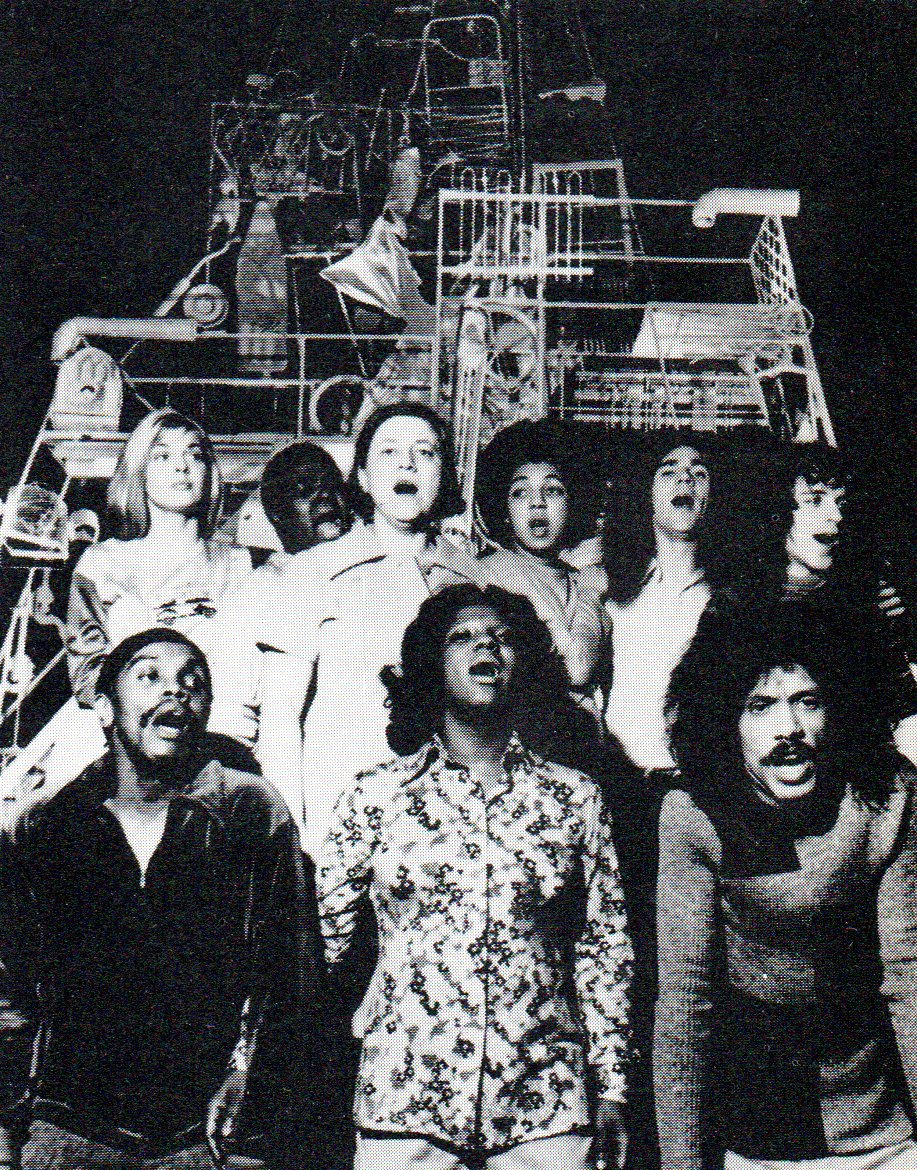
It attempted to theatricalize an amusing, satirical set of Eve Merriam poems about the pitfalls of inner city life within a dialogue-less, revue-like format. The 40 some-odd numbers, dealing with issues like drugs, crime, corruption, prostitution, and housing, were sung and danced by a nine-member company against an excellent Robin Wagner décor that incorporated the styles of various modern artists, including Jasper Johns and Claes Oldenburg. The stellar performances in the racially diverse company were by Black soul songstresses Delores Hall and Linda Hopkins.
Martin Gottfried felt that the few Whites in the show seemed out of place, and that the absence of Puerto Rican performers was a serious oversight. To simulate the reaction expected from a Black audience, actors placed in boxes offered phony call and response enthusiasm.
Clive Barnes called the show a “deep and dreary monocolor,” while Walter Kerr said it had “a minimum of wit,” two-dimensional characters, “penny plain” sociology, and “literal” visual effects. This “disappointment” was “overproduced,” staged in “terribly busy” fashion, and crammed with “embarrassing” obscenities, thought Douglas Watt. Edith Oliver rejected its “phony black” idiom, and Martin Gottfried dismissed its score as “nearly atrocious.”
Regardless of the show’s rapid demise, Linda Hopkins won a Tony for Best Supporting Actress, Musical.




.jpg?format=auto&width=300)