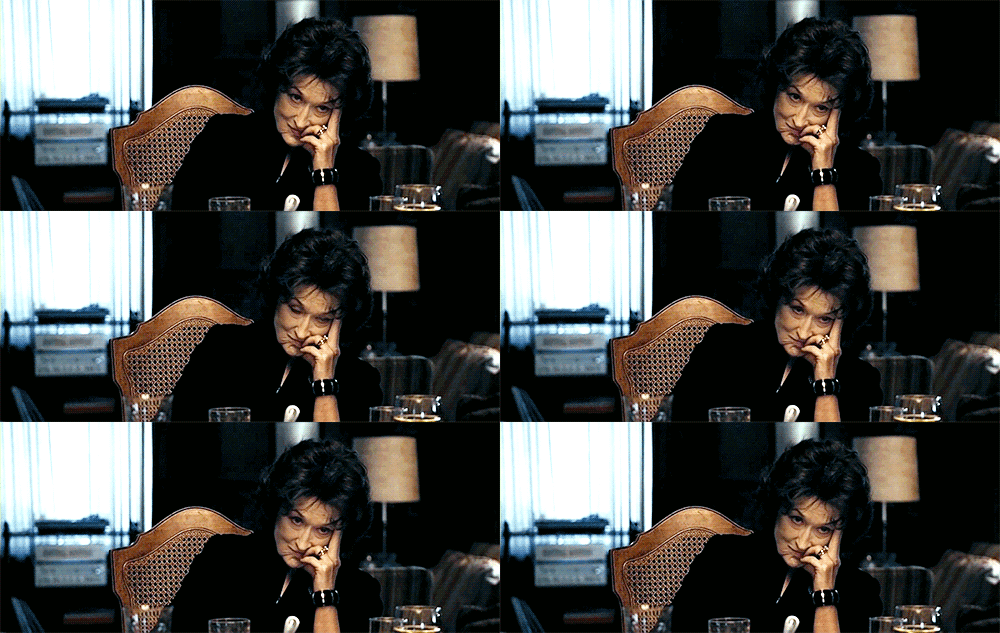
A rave from The New Yorker basically calling her performance "definitive" whilst not:
http://www.newyorker.com/magazine/2016/05/09/jessica-langes-harrowing-journey
O’Neill wrested his tale from his own heart, with cunning and fortitude.
Lange has all of that, too. I don’t want to call hers a definitive performance, because that would imply that her Mary is a kind of fly in amber—which is the last thing you think as you watch her jump from flirtatiousness to maternal concern, from junkie selfishness to contempt for male self-regard, from deviousness to the sting of loss. I’ve always had a deep admiration for Katharine Hepburn’s interpretation in Sidney Lumet’s extraordinary 1962 film of the play. Hepburn was never better than when using her face like a Kabuki mask to express Mary’s hurt; her downcast eyes and lips spoke volumes on top of O’Neill’s volumes. Obviously, Hepburn was helped by the camera; Lumet could zoom in on the rage and deceit. Because Lange is onstage—in medium shot, as it were—she has to call on different tools. First, there’s her voice. Her mellifluous, murderous sound—the way she raises her voice without raising her eyes, because she doesn’t want anyone to see her dope-dilated pupils—is a lesson in the power of intonation as a form of emotional expressiveness. Then, there’s her body. Lange is entirely free onstage, because she’s sure of her craft, of how to move when moving in for the kill or just trying to show interest in someone other than herself. (Particularly chilling is Lange’s understanding of how dope makes the skin itch; she scratches at her neck subtly to show us what Mary feels.) At the same time, Lange isn’t dying to be seen. She turns to look out the window or keeps her face averted whenever Mary feels trapped or is planning a new lie. Lange forces us to listen more acutely to what Mary is saying, to register how her body language contradicts her brazen imagination.
The director, Jonathan Kent, handles Lange’s genius the way it should be handled—by stepping to the side, letting you see that it’s there but not interfering. (His only real flaw is the set, which is pitched at an angle, thus limiting the audience’s view.) Of course, Lange’s performance wouldn’t be possible without her co-stars, who clearly love her without necessarily being up to her level. (, uninspired, either, and he illuminates aspects of James that I never fully felt before: his status as an immigrant, a perennial outsider, and his role as an enabler—in effect, James is paying for everyone’s addictions in more ways than one. Shannon doesn’t connect very well during the first part of the nearly four-hour evening, but, as Mary turns against Jamie, he finds his character, a man who’s trying to be a man, if only he can get beyond his desire to be infantilized by a mother who long ago abandoned him. Mary and Jamie are the realists in the family. They know who they are, while James and Edmund just want the world to be different. It’s thrilling to watch Shannon go toe to toe with Lange as Mary deteriorates and grows chemically stronger, and as day lapses into night, in that house, which is miraculously—despite the wreckage within—still standing. ♦
Updated On: 5/5/16 at 01:20 PM