Understudy Joined: 7/7/10
I've heard and read the word "pastiche" many times about musical theatre songs. I recently heard an interview with James Marino and John Kander about the term and even they seem to be stumped on what it means. What is the difference between pastiche songs and other songs in a musical?
Thanks, all.
A Pastiche is a show that is current but "old-fashioned" in style. For example Thoroughly Modern Millie and Drowsy Chaperone were new musicals, but 1920's style, so they are a pastiche of the 1920's musicals.
I didn't think it necessarily meant 'old-fashioned' but any songs that imitate another style etc.. could be 'pastiche', I thought.
Imitation, but also inauthentic to a degree.
a literary, musical, or artistic piece consisting wholly or chiefly of motifs or techniques borrowed from one or more sources.
The above is from the dictionary. Nothing old fashioned, nothing inauthentic. Just "borrowed". (the 2nd definition only refers to "hodgepodge")
(So G is the winner.)
Understudy Joined: 4/1/11
A pastiche is something that is written or painted in the style of another artist, writer or composer. It's obviously only inauthentic, if it claims to be the work of that artist.
The Boyfriend, perhaps, is the perfect pastiche of a Twenties musical - where Drowsy may have a few numbers that sound as though they might come from that era, the show is more of the meta-variety than pure pastiche. Millie also has a plot that probably wouldn't appear in a Twenties musical, but there are some numbers that might sound as though did come from that period.
Understudy Joined: 12/31/69
Pasticcio musicals were very common in the late 1800's and early 1900's when musicals were forming in the United States. they would 'borrow' scenes, music, styles and mix it in a blender and turn it into a new product. Example: lady gaga's career.
Nowadays-- it can also be called copyright infringement.
The Black Crook- for example- was based on Faust.
a common day pastiche musical would be a school talent show.
Where music from different composers are used for one show- and unauthorized.
whenever I hear that word I just look at the root word and think - to paste.
copy/paste
None of the above.
It's a literary term for a work that imitates another style (not necessarily an older style), in a manner that doesn't ridicule or lampoon the prior work, but rather celebrates it or "sends it up" or, even, pays tribute to it.
So "You Could Drive a Person Crazy" is a pastiche song, deriving its style from Andrews Sisters songs of the 1940s, but with a sensibility contemporary to its 1970 setting.
Sondheim wrote much of the score to Follies as deliberate pastiche songs: "Broadway Baby" (De Sylva, Brown and Henderson), "Losing My Mind" (Harold Arlen), etc.
Hairspray could be considered a pastiche show.
Understudy Joined: 4/1/11
You Could Drive A Person Crazy is a parody - it exaggerates a style for humorous effect - at no time would you think that the Andrews Sisters ever sang it.
The Follies numbers are pastiche, because in context they are performed as if they were numbers of the period.
Pastiche has two meanings. It can be something deliberately written to be evocative of a particular style or era, or even a particular artist. In that sense, it's usually followed by a qualifier, as in "it's a pastiche of...". It can also mean something that combines several styles or moods. Follies fits both meanings.
I always thought it was pasta dish
The entire first Act of Grey Gardens consisted of Pastiche songs.
Except for the songs sung by Edie of course.
Whenever someone mentions pastiche, I think that it's only a pastiche if the the imitation was designed to be a reference to a previous work.
I don't think a talent show is pastiche. I would only consider something a pastiche if the composer/lyricist makes me think "This sounds like [fill in the blank]." If the kids are actually performing the songs of the composers, I don't think it's pastiche. For example, a kid sings "The Sound of Music" and another sings "Defying Gravity," I don't think it's pastiche because they're not referencing (or referring to, whichever is grammatically correct) another work.
Pastiche

Here's Corine, showing she knows what pastiche means.
The most basic way to think about it is parody without humor.
Aren't the opera scenes (with Carlotta and Piangi) in The Phantom of the Opera considered pastiche? They simulate styles of grand opera, but are obviously inauthentic, even (intentionally) comical.
And Joseph and the Amazing Technicolor Dreamcoat, too, which has songs that simulate everything from country to calypso.
Broadway Legend Joined: 5/15/03
Most of the scores of BALLROOM and OVER HERE are pastiche.
Understudy Joined: 7/7/10
Okay, so it seems that "pastiche" means to evoke another style. What would NOT be considered pastiche, then, since so many musical theatre songs are based in other genres (rock, opera, etc.)?
Please forgive me if I seem completely naive on this subject.
Out and out parody. Some times the line gets a little blurred , for example, Urinetown crosses the border between parody and pastiche many times.
Understudy Joined: 4/1/11
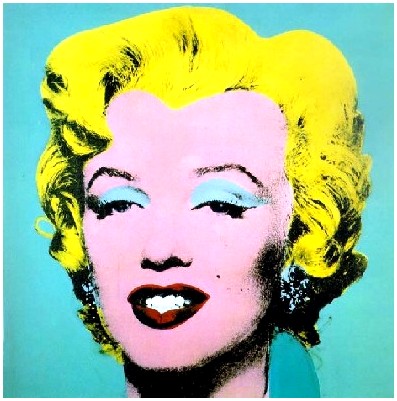
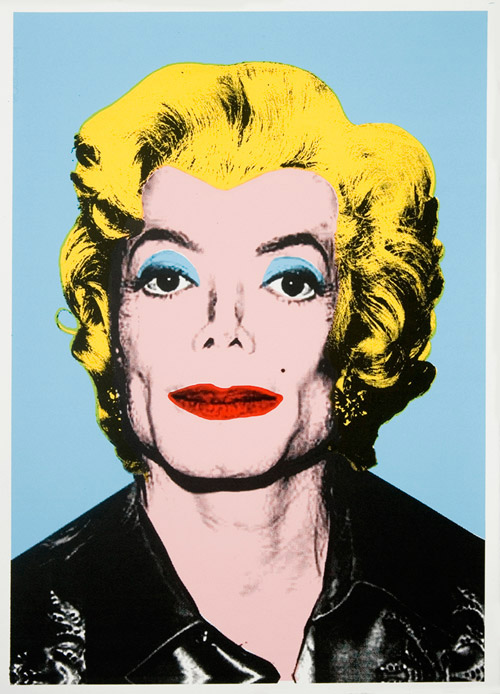
Parody and pastiche are quite different. Perhaps pictures might help:
[img]
[/img]
This is the original Warhol image of Marilyn Monroe, with which we're all probably familiar.
[img]
[/img]
Banksy produces a pastiche of the original, using Kate Moss instead of Marilyn, to make a point. At first glance, we might even think it is an original but Kate Moss as a sitter is not right and her expression is markedly different. So rather like Losing My Mind in Follies - we are given a piece that is very similar to a Gershwin number or a torch song, but it is used in a way that we might not expect to make a different point.
[img]
[/img]
The same cannot be said for this, which parodies the sitter in the style of Warhol and one could argue has something to say about the original. But we also understand it is not the original and we understand that our reaction is not to take it seriously (unless one is a Michael Jackson fan, perhaps). So like, You Could Drive A Person Crazy, the juxtaposition of the style of the song and the individuals involved, allow us to understand the situation and also to laugh at it.
[img]
[/img]
In this case, we have a print in a style reminiscent of Warhol. We understand it is neither an attempt to recreate the original nor make a point, it just gives us the Warhol ambiance. So just as a score of a musical maybe jazzy or have rock influences - it's not trying to persuade us that it is a specific writer, it's borrowing the flourishes of that style to give the piece a little colour.
Updated On: 6/5/11 at 08:46 AM
"Okay, so it seems that "pastiche" means to evoke another style. What would NOT be considered pastiche, then, since so many musical theatre songs are based in other genres (rock, opera, etc.)"
I'd say that pastiche has to be specific. You can't, for example, do a musical pastiche of "the twenties", because there are so many different types of music from the time. You can, however, do a pastiche of Cole Porter or Jerome Kern. In that same vein, you can't do a musical pastiche of the genre of "rock", because, again, that is far too wide. You can do a pastiche of a certain artist, or a specific sort of music (a pastiche of Charleston music, a pastiche of rockabilly).
Videos