Alm, of course I don't mind, and that is pretty much what I do mean.
I disagree with you that the book of Follies is good because it "provides characters and situations about which the songwriter is able to write great songs, and moves the show from one song to the next in such a way that the show doesn't become boring." The book of Follies does indeed do that. And for a book of a musical to do that is a necessary thing. But I can't agree with you that a libretto doing that alone is sufficient to make it a good libretto. Nor can I agree with you that, a libretto having met those criteria, a show's consequently not being a bore means that the show is a good, let alone a great (if great be your implication), show. I might perhaps call a show that doesn't bore me at least "fair," but that's hardly a reason to call it "good."
All it means is that the show is not boring.
I don't judge a book show's greatness by it merely having a fine score and not being boring. I judge a book show to be perfect when all the elements, chiefly the book and the score, seamlessly balance and resonate to create a narrative and or elucidate a concept. I judge a book show to be great when it comes thrillingly close to accomplishing that.
But I can't judge a book to be even "good" when, although a serviceable platform for an impressive score, it doesn't even come close to matching its score in depth, wit, feeling, and engagement. And I insist that a "good" book do more than merely "provide" characters who are able to come to life in song. Instead, I want those characters, when they are not singing, to be people who interest me. Perhaps not to the degree they will in musical performance. But certainly not merely to a threshold that keeps me from leaving the theater out of utter boredom.
Follies is tough. And highly ambitious. The four principles are at a breaking point. They have greatly disappointed themselves and their spouses. They question whether life, once so full of promise, when "everything was possible and nothing made sense," has become unbearable; whether their futures, on their present course, are unsustainable. The dialogue for a book musical with these kinds of psychological demands needs to rigorously challenge and engage the audience and profoundly resonate with, in Follies' case, the exquisite lyrics of its landmark score.
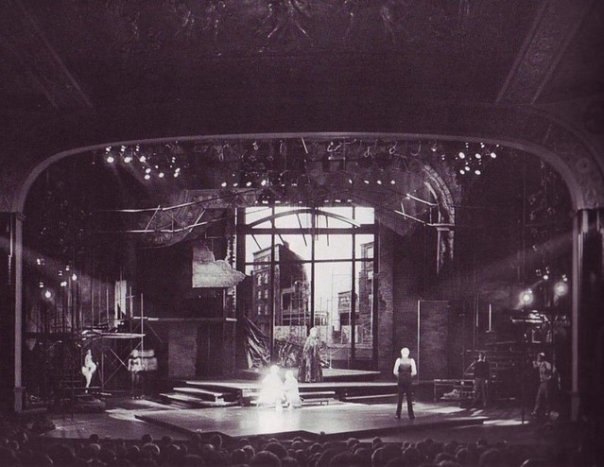
I know of only one moment in "Follies" where the context and dialogue of the libretto comes close to engaging the audience's imagination on that level (ok, I'll speak for myself: engages my imagination on that level). It is a moment which gives me a hint of the show that could have been. It's the final curtain.
Phyllis, Ben, Buddy and Sally have left the theater. The stage doors close.
Young Ben and Buddy enter below. Young Phyllis and Sally enter from upstairs. The spoken greetings from "Waiting for the Girls Upstairs" are repeated.
Young Sally: Hi.
Young Ben: Girls.
Young Phyllis: Ben?
Young Buddy: Sally.
Curtain.
* * *
I find this moment beautiful, emotionally satisfying, and highly dramatic. We see the principles again when they are young, with so much that could happen. And yet see them as "ghosts." But quite differently than we have before. We see them alone on stage, without their older selves, for the first time.* Something has perhaps, just perhaps, changed. Once again "everything is possible and nothing ma[kes] sense." Which can only make us wonder what will happen to their older counterparts now that the reunion is over. It isn't at all clear what will happen, but the ambiguity - a Sondheim staple perfectly matched in a libretto for a Sondheim show - is palpable.
Truly great book musicals, of the dramatic variety which Follies aspires to be, in which the characters' souls take on similarly challenging, sometimes treacherous, journeys, or are, in any event, rawly exposed to the realities of life - here I would suggest, as examples, Show Boat, Carousel, South Pacific, Fiddler, A Chorus Line, Gypsy, West Side Story, Lost in the Stars, The Fantasticks, Cabaret, Into the Woods - feature, throughout the course of their librettos, many moments that achieve this level of poignancy, and so imaginatively reveal character and elucidate theme through spoken dialogue and set piece semiotics.
All good book musical librettos - be they of the dramatic genre addressed above, or in any other style, whether Bolton and Wodehouse frolics, Hammerstein epics, Brecht vaudevilles, Masteroff romances, etc., etc., etc. - consistently mesh character, action, motive, sentiment, humor and pathos to resonate with and evocatively support their scores.
By these measures, the libretto for Follies falls short of "good."
(as always, the above is merely my personal opinion and in no way demands that anyone agree with me, or is meant to suggest that anyone who doesn't is wrong because I am always right).
* with the exception of their fine double duets in Loveland.
Updated On: 8/15/11 at 08:17 AM




.png?format=auto&width=365)




